


SCAI's legislative advocacy efforts are deeply focused on issues that improve interventional cardiology practice and protect patient access to care. SCAI government relations staff and SCAI PAC and Advocacy Committee members have met individually with over 100 Congressional offices this year to educate lawmakers on key issues contained in the bill. Several provisions of H.R. 1 that passed the House on May 22, 2025, include:
Physician Reimbursement
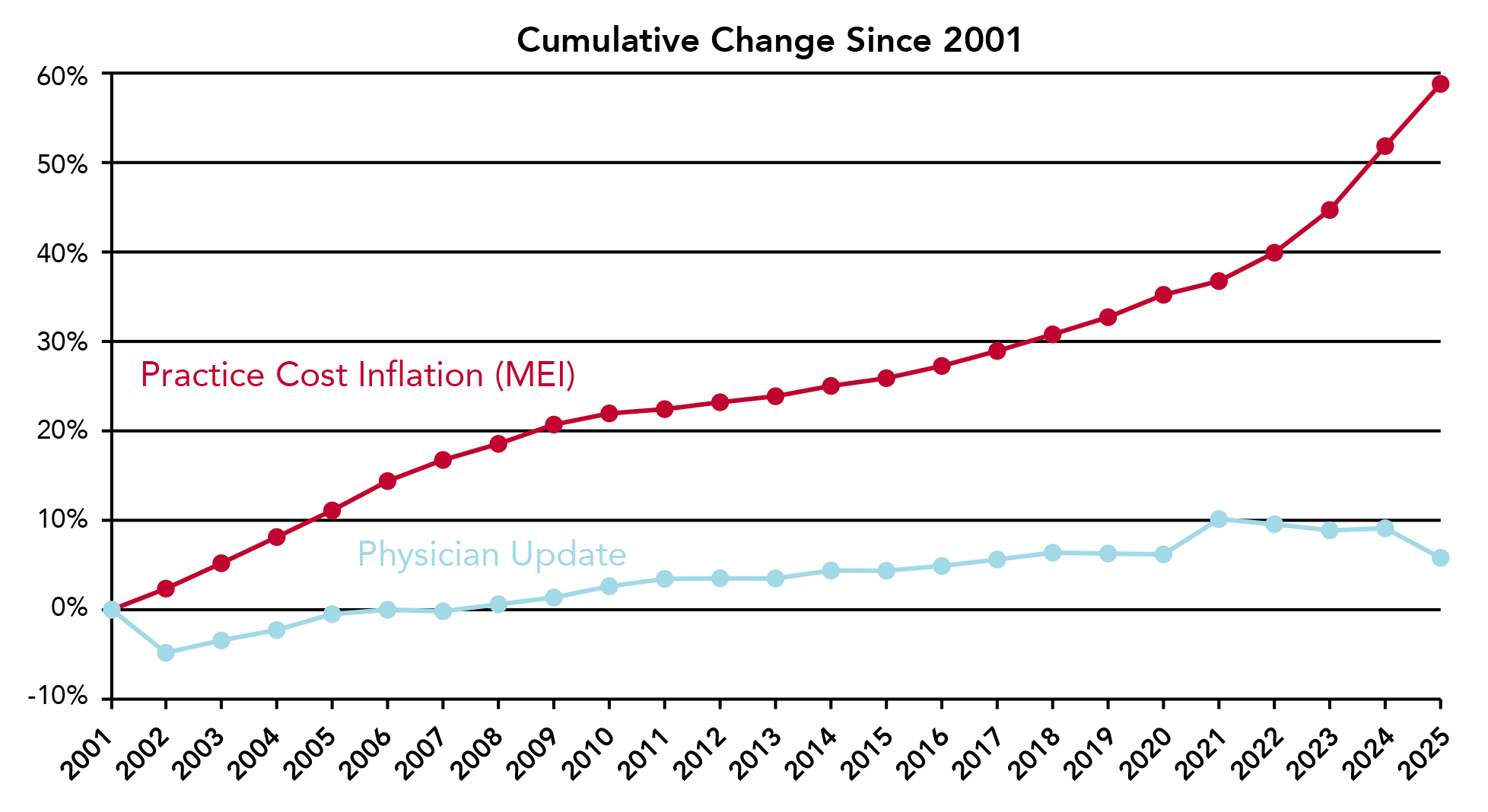
Initially contained in H.R. 879-Medicare Patient Access and Practice Stabilization Act, a provision of the bill would stop the 2.83 percent cut in Medicare payments to physician payments to physician practices this year while providing a 2 percent payment update. A pay increase for doctors who receive payment via Medicare for services would be provided in each fiscal year from 2026 through 2033.
Unfortunately, the legislation would initiate $500 billion in automatic Medicare cuts. Following the Pay-As-You-Go (PAYGO) Act, any new spending must be offset by automatic cuts to prevent deficit spending. These Medicare cuts are restricted to 4% of its annual budget, though PAYGO rules have been waived in recent Medicare-related legislation.
Medicaid Payment and Enrollment
The bill proposes cuts to Medicaid provider payments affecting physicians and other healthcare providers. It introduces work requirements for Medicaid beneficiaries and alters enrollment and eligibility criteria, which may result in people losing coverage and other reductions. SCAI has worked to mitigate reductions and increase Medicaid access.
For example, originally known as H.R. 1509/S752, the Accelerating Kids Access to Care Act, the bill now contains provisions allowing children enrolled in Medicaid or CHIP to access specialists across state lines when none are available locally, ensuring necessary care.
Student Loan Interest Deferral
A provision aimed at helping Residents defer interest on their student loans during their training was included in the bill, capping the deferral amount at $150,000. Although preventing interest accrual on $150,000 is an improvement over the current situation (which does not allow any interest deferrals), SCAI supports removing this cap so it applies to all student loan debt acquired during medical training. Therefore, SCAI is endorsing H.R. 2028/S.942, the Resident Education Deferred Interest (REDI) Act. See Section 30011- Loan Limits (in Title III on Education and the Workforce).
Large and complex bills like H.R. 1 inevitably contain elements that could be refined. SCAI, along with other healthcare societies, expresses concern over the inclusion of a provision that eliminates the ability of certain pass-through entities, specifically those defined as specified service trades or businesses (SSTBs), to deduct state-level pass-through entity taxes (PTET) on their federal returns. We urge the Senate to reinstate the PTET deduction in their version of the reconciliation bill, as its removal would impose an additional tax burden, making survival difficult for small practices.
State Tax Pass-Through
Legislative action now moves to the Senate where SCAI is working to improve this proposal before it is enacted into law and signed by the President.
If you have any questions or comments please email:
Concerned About This and Other Issues?
Learn More About SCAI's Latest Work on Your Behalf